
The "Once Upon a Time Luxembourg" project continues
This academic year we are continuing our ZhBL project.
The history of the small Duchy of Luxembourg is amazing and unique.
There are so many secrets and legends on this earth.
The very first legend worth mentioning is, of course, the legend of Melusin.
The founding of the fortress city of Luxembourg is associated with it.
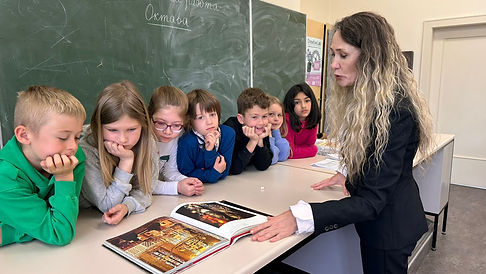
During the lesson, the children talked about their impressions of Luxembourg and what they especially like about it.
Many people already know the legend of Melusin.
We even conducted a small quest to test our knowledge of Luxembourg.


.jpeg)
.jpeg)


On October 29 and November 3, excursions were organized for school teachers to get acquainted with the ancient history of the Grand Duchy, more precisely with the history of its military fortresses.
The tour participants walked through Kirschberg, an area in which there were numerous military fortresses and fortifications.
After passing through the Green Forest, you find yourself at the Three Acorns Fortress, which is also called Thüngen, in honor of its commandant, Baron Adam Sigmund von Thüngen. This is all that remains of the once powerful defensive fort, built in 1732. In those days, the fortress was surrounded by ditches, and it was possible to get into it only through a 170-meter tunnel. At the moment, only part of the stone foundation and towers located along the edges of the rocky cliff remind of the invincibility of the fort.
In 1867, the fortress was almost completely destroyed. It existed in this form until 1990, when, simultaneously with the construction of the nearby Museum of Modern Art, the fortress was completely reconstructed.
How interesting it was to walk through the underground passages, admire the panorama of the city, and climb the remains of the fortress walls. Even rain and cool weather did not prevent our excursionists from immersing themselves in the mysterious world of ancient history.

In celebration of Dix's 200th anniversary
Who is La Fontaine? Of course, it's the French fabulist Jean de La Fontaine. Worldwide, except in Luxembourg. There, La Fontaine is the poet and classic Luxembourgian literary figure Edmond de la Fontaine (1823-1891). But in Luxembourg, he's more commonly known by his nickname, Dix.
2023 is a significant year for literary Luxembourg. This year marks the 200th anniversary of the birth of one of the founders of Luxembourg literature, Dix (the pseudonym adopted by Edmond de la Fontaine).
And we, as part of the project, could not miss this event.
During the lesson, the children learned about Dix's biography and work and even decided to put on a short performance based on the fairy tale "The Wolf and the Fox."
We started writing a script together, preparing costumes and assigning roles.

.jpeg)

.jpeg)
.jpeg)
.jpeg)
The performance based on Dix's fairy tale "The Wolf and the Fox" is ready.
Meeting Saint Nicholas Clesien
Dear Clesien, good Clesien
Come to us quickly.
We are really looking forward to it
And we hope you're already on your way.
On the gift window
Our slippers are standing,
After all, there are surprises and hotels
You will make the guys happy.
Nicholas - saint, Klesien, Klaus, Nicolas,
On New Year's Eve, every home is waiting for you.
You fly along the snowy road, quietly sliding on a sled,
People need hope so much, we can’t be late for them.
February 2nd is celebrated in Luxembourg as Liichtmëssdag.
Museum Day at Kalinka School
On February 10, 2024, classes at Kalinka School were held on-site. It was "Museum Day."
Our little Sparrows visited the Museum of Nature and Natural History.
At the entrance they were greeted by a little hedgehog, to whom the children sang a song with elements of finger gymnastics.
Then they approached a large, handsome albatross, were surprised by his large size, and sang to him about the sea and the fish that he loved very much.
And then something amazing happened!
The boys suddenly found themselves in space among the stars!
We took a ride on a musical rocket and tried on the roles of stars.
Step by step, the children learned many new and interesting things. They observed the lives of ants and their efforts.
We looked into the hollow where the bats were hiding.
We got acquainted with the structure of the human body.
We learned how bees pollinate flowers.
We learned about electronic devices that allow us to observe and experiment with various natural phenomena.
And the boys learned a lot of other things.
And our Finches and Kinglets visited the Luxembourg Tram and Bus Museum.
The children learned about the history of transportation, saw interesting exhibits, and sat and played in a historic tram.
The quest organized for the kids was a blast. Our kids know and can do so much!
Simply great!!!
And the middle school students visited the National Museum of History and Art.
This museum, located in the upper town, is very rich in artefacts from all eras of Luxembourg history.
How did primitive people live?
How does their home differ from modern ones?
What was the ancient fibula pin used for and what was it made of?
How did they store food in the past?
What did you eat it from?
How did you get around?
What is a mosaic?
Who are the muses?
Our students sought answers to these and other questions while exploring the museum exhibits.
Veronika Lobanova, an art teacher, also held a master class on making bookmarks, which the children decorated with an antique geometric ornamental motif – a meander.


Cooking bowenshloop
As part of the "Once Upon a Time in Luxembourg" project, the children learned about Luxembourg cuisine and prepared a traditional Luxembourg dish—Bouneschlupp, a green bean soup. And at the end, everyone tasted it together—it was delicious!!!👍🏼
Sunday Pretzel
Do you like pretzels? The pretzel is more than just a sweet pastry, it's also a symbol of centuries-old traditions and wonderful customs. One legend links it to the intertwined hands of lovers, another claims the shape of the pretzel resembles arms crossed over the chest, and a third claims the pretzel was invented by a baker commissioned by the Bavarian king to bake a loaf of bread through which the sun could be seen three times.
In Luxembourg, on the fourth Sunday of Lent, according to an old local tradition, a man gives his beloved a pretzel as a token of his love. If the feelings are mutual, the woman reciprocates by giving him an egg on Easter. However, if the feelings are not reciprocated, the man receives only an empty basket.
Interestingly, this tradition reverses itself during leap years: now the woman gives her beloved a pretzel, and the man, in return, gives an Easter egg. This additional twist makes the tradition even more captivating and mysterious.
Thus, the pretzel becomes not just a treat, but also a symbol of love and devotion.
Emaisien
On the first Monday after Easter, the Emaisien pottery fair traditionally takes place in Luxembourg City on the Fish Market square next to the Grand Ducal Palace. The main product at this fair is the Pekfilchen, a clay whistle shaped like a bird that produces a sound similar to a cuckoo's song. A similar traditional fair is held in the western village of Nospelt, famous for its potters. You can also visit a wonderful pottery museum there.
Octave
On April 20 (usually the third Saturday after Easter) the Octave began in Luxembourg.
The Octave Festival in honour of the Blessed Virgin Mary is the main religious event of the Catholic year in Luxembourg.
During this period, parishioners from Luxembourg, the German Eifel, the Belgian province of Luxembourg and the Lorraine region of France make a pilgrimage to the cathedral of the capital of Luxembourg.
As early as the 17th century, people turned to the Holy Mother of God for protection from the terrible plague. And their prayers helped.
And since then, pilgrims have come to thank the patroness of Luxembourg.
On the outskirts of the city, pilgrims gather in a procession and then walk to the Cathedral.
After services in the cathedral, pilgrims can find food and drink at the Octave Market (Oktavsmäertchen) on Place Guillaume (Knuedler). This market has long been part of the Octave Festival tradition. The Octave Festival concludes with a festive procession carrying a statue of the Virgin Mary through the streets of the capital. Members of the Grand Ducal House, representatives of the Government, the Chamber of Deputies, the courts, and other institutions are present in the procession.

%20(1).jpeg)

Museum Day 2
On Saturday, April 27, there was a “museum day” at Kalinka School.
Our students love this format of classes, as it allows them to go beyond the confines of traditional classroom lessons and learn and see many interesting things outside the classroom.
The younger students took a trip to the Nature Museum, where an exhibit on asteroids and other celestial bodies is currently open.
The middle-school students visited the Villa Vauban Museum, where they immersed themselves in the world of art and tried their hand at animal painting.
The older children went on an excursion to the Green Forest to learn about the ancient history of Luxembourg and the Olisie castles, catacombs, and the Three Acorns fortress.
Overall, it was a busy day! The kids were a little tired, but they were very happy!
Sprangpressessioun "Dancing Procession"
Every year on the first Tuesday after Whitsuntide, the Sprangpressessioun (Dancing Procession) takes place in Eschternach, Luxembourg's oldest town.
According to one legend, the history of this procession begins in 1347. At that time, the abbey and its surroundings were engulfed by an epidemic, and the residents of Eschternach decided to organize a religious procession, believing that it would help stop its spread.
Nowadays, a procession of pilgrims and musicians passes through the entire city, covering a distance of about a kilometer and a half, dancing in a unique manner. The dance resembles a leap: one step to the right and forward, one step to the left and forward. The participants stand in rows of five or six, holding onto the ends of triangular scarves, and as soon as the music begins, the procession begins to leap.
Every year, the procession attracts thousands of pilgrims and spectators from Luxembourg and neighboring countries. Since 2010, the dancing procession has been included on UNESCO's Representative List of Intangible Cultural Heritage.
Excursion to Eshternach
As part of the ZhBL project, children from the Kalinka school went on an excursion to Eshternakh.
We traveled through time and space, visiting the oldest city in the Grand Duchy. The tour included the Roman Villa, the Basilica containing the relics of the Abbey's famous founder, Willibrord, the Eschternach Abbey Museum, and a picturesque town square with its old buildings.
During the three-hour tour, we learned and saw many interesting things. But many more fascinating stories and secrets of this city await us on future excursions.
June 23 -
National Day in Luxembourg
June 23 is a national holiday in Luxembourg.
Luxembourgers call the holiday Groussherzogsgebuertag (Grand Duke's birthday) or Nationalfeierdag (National Day).
Why is it celebrated on June 23?
During the lesson as part of the JBL project, our students learned about the coat of arms, flag, and anthem of Luxembourg.
We found out why this holiday is celebrated on June 23.
We learned about the beloved and respected Duchess Charlotte.
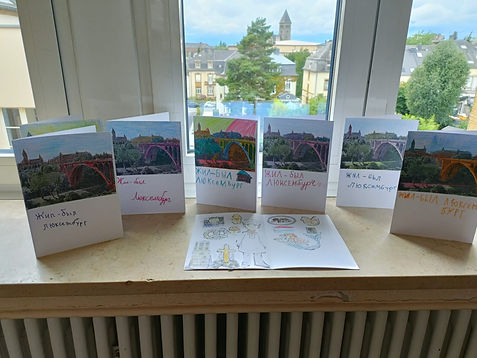
During the lesson, we also designed postcards with views of the Adolphe Bridge in the style of Jacques Schneider, a contemporary Luxembourg photographer and artist.


Holidays are coming soon!
There were so many interesting things during our project about Luxembourg!!!
We concluded this year with an exhibition of postcards entitled "Once Upon a Time There Was Luxembourg".
.jpeg)

.jpeg)

.jpeg)
.jpeg)

